
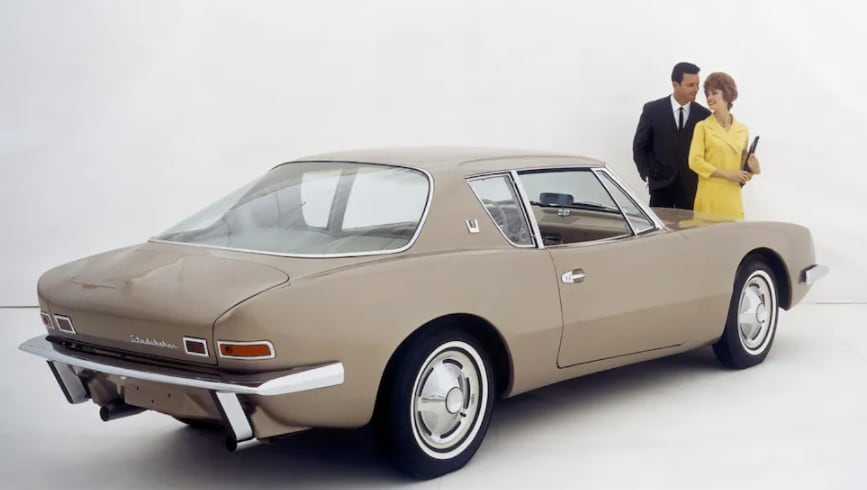
60 years ago, Studebaker dropped a bombshell on the 1962 New York Auto Show as it unveiled a jaw-dropping fiberglass sportscar with its “Jet-Thrust” V8 engine. At the same moment, the Studebaker Avanti was revealed to the company’s annual shareholders meeting in South Bend, IN. The curvaceous Avanti would soon be clocked at the Bonneville, UT salt flats at near 200mph — making a supercharged Studebaker the fastest production car available that year, beating even the Corvette.
Backing up the audacious claim as “America’s Most Advanced Automobile” was a bevy of Avanti safety features like an integrated roll bar, the first disc brakes on a U.S. car, seat belts (still not required in 1962), a padded interior, and airplane-like gauges that glowed red at night (as expected by pilots.)
Industrial Designer Raymond Loewy assembled the four-man team that gave the Avanti its trademark swooping good looks in a crash three-week design program. Later, Loewy would boast that the Avanti has no straight lines at all.
The first Avanti cars were quietly assembled despite a strike at Studebaker’s normally somnolent factory. Soon enough, the explosion of publicity created a wait list that would leave thousands of potential customers waiting so long that many canceled orders.
In a sense, the Avanti was TOO popular. Production problems plagued assembly lines, as the automaker struggled with ill-fitting fiberglass components. The body includes more than 120 fiberglass pieces fitted around an existing chassis and engine platform. By the end of 1963, Studebaker ended U.S. production of ALL of its cars. Built in November 1962, my Studebaker Avanti is #662 of 4,647 that left South Bend production lines and was originally the same “Avanti Gold” color as the prototype Avanti pictured above.